
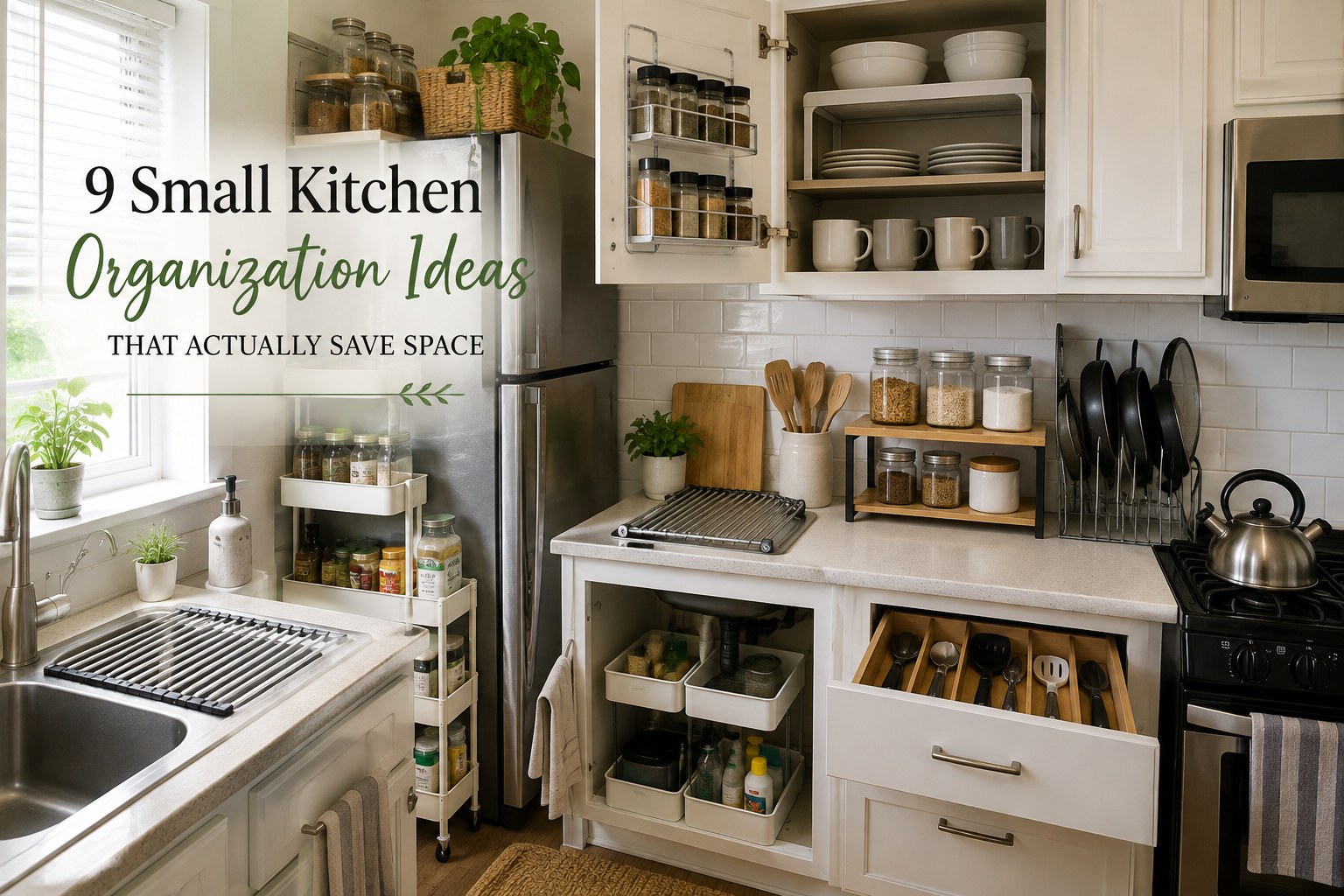
A small kitchen doesn’t necessarily need more cabinets. Sometimes the best storage space is already there—above your dishes, around the plumbing, behind a cabinet door, beside the refrigerator or even across the sink.
The trick is finding those overlooked spaces and using them without making an already-small kitchen feel even more crowded.
These nine small kitchen organization ideas tackle a different storage problem each. Instead of filling your kitchen with more furniture and containers, they help you make better use of the space you already have.
Disclosure: As an Amazon Associate I earn from qualifying purchases. This post contains affiliate links, which means I may earn a commission from qualifying purchases at no additional cost to you.
1. Use the Empty Space Above Your Dishes
Open one of your kitchen cabinets and look above your mugs, bowls or plates. Is there a big patch of empty air?
Cabinet shelves are often spaced far enough apart to accommodate tall items, which means shorter dishes can leave a surprising amount of vertical space unused. Stacking everything higher isn’t always the answer—you then have to move half the cupboard every time you want something from the bottom.
A simple shelf riser creates another usable level.
Our pick: SONGMICS Cabinet Organizer Shelves, Set of 2
The SONGMICS organizers provide two separate raised shelves that can be arranged according to the space available. They work particularly well for separating mugs, bowls, plates or pantry items that would otherwise be stacked together.
Best for: Cabinets with plenty of height but not enough actual shelf surface.
Before you buy: Measure the internal width, depth and height of your cabinet. Don’t assume the organizer will fit simply because the cabinet looks spacious.
(paid link)
2. Reclaim the Awkward Space Under the Sink
The cabinet underneath a kitchen sink can be surprisingly large—and surprisingly useless.
Pipes divide the cabinet into awkward sections, bottles disappear at the back, and traditional rectangular shelving may not fit around the plumbing.
An L-shaped organizer tackles that problem by deliberately leaving room around the pipes while adding another level of storage.
Our pick: Amazon Basics L-Shape Under-Sink Pull-Out Organizers, 2-Pack
These organizers have an L-shaped frame and a pull-out lower shelf, making items at the back easier to reach. The set includes two organizers, so they can be used together in a wider cabinet or separately.
At the time of our research, the assembled dimensions were approximately 13.8 × 10.5 × 12.6 inches per organizer.
Best for: Deep under-sink cabinets where plumbing gets in the way of normal shelving.
Before you buy: Measure the actual usable space around your pipes, garbage disposal, hinges and other fittings—not just the overall dimensions of the cabinet.
(paid link)
3. Store Pans Vertically Instead of Stacking Them
The traditional frying-pan storage system goes something like this:
Put every pan on top of every other pan.
Then discover that the pan you need is at the bottom.
A divided rack lets pans, lids, baking sheets and cutting boards stand vertically instead. You can remove one item without dismantling the entire stack.
Our pick: Simple Houseware Expandable Pan Rack
This organizer has adjustable dividers and an expandable base, so you can change the spacing to accommodate different cookware.
It isn’t limited to frying pans either. The compartments can also be useful for pot lids, cutting boards and baking sheets.
Best for: Lower cabinets containing a mixture of pans, lids, boards and baking trays.
Before you buy: Check both the cabinet dimensions and the diameter of your largest cookware. The rack expands to roughly 22 inches, but it doesn’t need to be used at its maximum width.
4. Turn the Inside of Cabinet Doors Into Storage
Cabinet doors occupy space but normally provide none.
That’s an opportunity.
Small hanging or adhesive baskets can turn the inside of a cabinet door into storage for spices, packets and other small kitchen items without taking away shelf or counter space.
Our pick: FAMNONE 2-Pack Adhesive Cabinet Door Organizers
These steel baskets mount to the inside of a cabinet door using adhesive rather than requiring a permanent shelf installation.
They’re particularly useful for smaller items that tend to get lost behind larger things.
Best for: Small items taking up valuable cabinet shelf space.
Before you buy: Check the clearance inside the cabinet carefully. Make sure the basket and its contents won’t collide with shelves or other items when you close the door. Also check that the mounting method is appropriate for your cabinet surface.
5. Borrow Workspace From Your Sink
A traditional dish rack can occupy a substantial part of a small countertop all day—even when there aren’t any dishes drying on it.
A roll-up rack takes a different approach.
It stretches across the sink when needed and rolls away when you’re finished, temporarily turning otherwise-unused sink space into a drying or working surface.
Our pick: Ahyuan Roll-Up Dish Drying Rack
The Ahyuan rack uses stainless-steel rods with silicone ends and comes in multiple sizes. Besides drying dishes, this type of rack can provide a temporary surface for rinsing produce and other light kitchen tasks.
Then it can simply be rolled up and stored.
Best for: Kitchens where a permanent dish rack consumes too much counter space.
Before you buy: Measure your sink first. The rack needs enough overlap on both sides to sit securely. Choose the size based on the dimensions of your actual sink rather than assuming a standard size will fit.
6. Turn That Weird Narrow Gap Into Storage
Have a skinny, seemingly useless gap between the refrigerator and cabinet, or between two pieces of kitchen furniture?
It might be more useful than it looks.
A narrow rolling cart can transform a few inches of dead floor space into several vertical storage levels while remaining accessible because the whole unit pulls out.
Our pick: TEAMIX 5.5-Inch Slim Rolling Storage Cart
At approximately 5.5 inches wide, this four-tier cart is designed specifically for narrow spaces. It has wheels and a handle so you can pull the unit out rather than trying to reach items through the narrow opening.
Its listed dimensions during our research were approximately 15.5″D × 5.5″W × 31.5″H.
Best for: Narrow gaps beside cabinets, counters or appliances.
Before you buy: Measure the narrowest part of the gap. Watch for baseboards, handles, trim and anything else that protrudes into the available space.
If your gap is even narrower than 5.5 inches, slimmer carts do exist—but check dimensions carefully before ordering.
7. Give Food-Container Lids Their Own Home
Food-storage containers aren’t always the problem.
The lids are.
Different sizes and shapes get thrown into a drawer or cabinet, and finding the matching one turns into an archaeological excavation.
Instead of storing every container with its lid attached, nesting compatible containers and storing their lids vertically can use considerably less space.
Our pick: Lifewit Food Container Lid Organizer
This organizer uses adjustable dividers to separate lids into different sections, making it easier to group them by size or shape.
The version we researched measured approximately 10″D × 13″W × 3.5″H, with six adjustable dividers creating up to seven compartments.
Best for: Cabinets or drawers where loose container lids are creating most of the clutter.
Before you buy: Check the available footprint and measure your largest lids. An organizer can control the mess, but oversized lids still need enough space to fit.
8. Make Your Utensil Organizer Fit the Drawer—Not the Other Way Around
Fixed-size cutlery trays often leave strange strips of wasted space along the sides of a drawer.
In a large kitchen, that may not matter.
In a small one, every few inches count.
An expandable organizer can use more of the drawer’s available width while providing larger sections for cooking utensils alongside everyday cutlery.
Our pick: Simple Houseware Expandable Kitchen Drawer Organizer
This organizer has nine compartments, movable dividers and expandable side sections.
The version we researched expands from approximately 12.5 to 24.75 inches wide, is around 17.25 inches deep, and is approximately 1.75 inches high.
That relatively low profile can also be helpful in shallower kitchen drawers.
Best for: Wide or awkwardly sized drawers where a standard cutlery tray wastes space.
Before you buy: Pay particular attention to drawer depth. At roughly 17.25 inches deep, this organizer won’t suit every kitchen drawer.
9. Turn the Side of Your Refrigerator Into Storage
If one side of your refrigerator is exposed, you may have a large vertical storage surface sitting completely unused.
Magnetic shelves can move spices and frequently used small items out of cabinets and off countertops without drilling holes into a wall.
Our pick: HuggieGems Magnetic Spice Racks, 4-Pack
This four-piece magnetic set attaches directly to a compatible refrigerator surface and can be repositioned when needed.
It’s particularly useful for spices and other smaller items that you want within easy reach while cooking.
Best for: Kitchens with an exposed magnetic refrigerator side and limited cabinet or counter space.
Before you buy: This is important: make sure the intended surface is actually magnetic. Not every refrigerator exterior will hold magnetic organizers. Test the exact location with an ordinary fridge magnet before ordering.
The Best Small-Kitchen Storage Space May Be the Space You’re Ignoring
When a kitchen feels too small, buying another cabinet or piece of furniture isn’t always the answer.
Look for the space that’s already there:
above short items in cabinets, around sink pipes, behind doors, over the sink, inside narrow gaps, across the full width of drawers and on unused vertical surfaces.
You don’t need all nine of these organizers.
Start with the place in your kitchen that annoys you most. Measure it carefully, choose the solution that addresses that particular problem, and see how much usable space you can recover before adding anything else.